Insights
Stracl is a SaaS platform purpose-built for enterprise Organization Change Management (OCM).
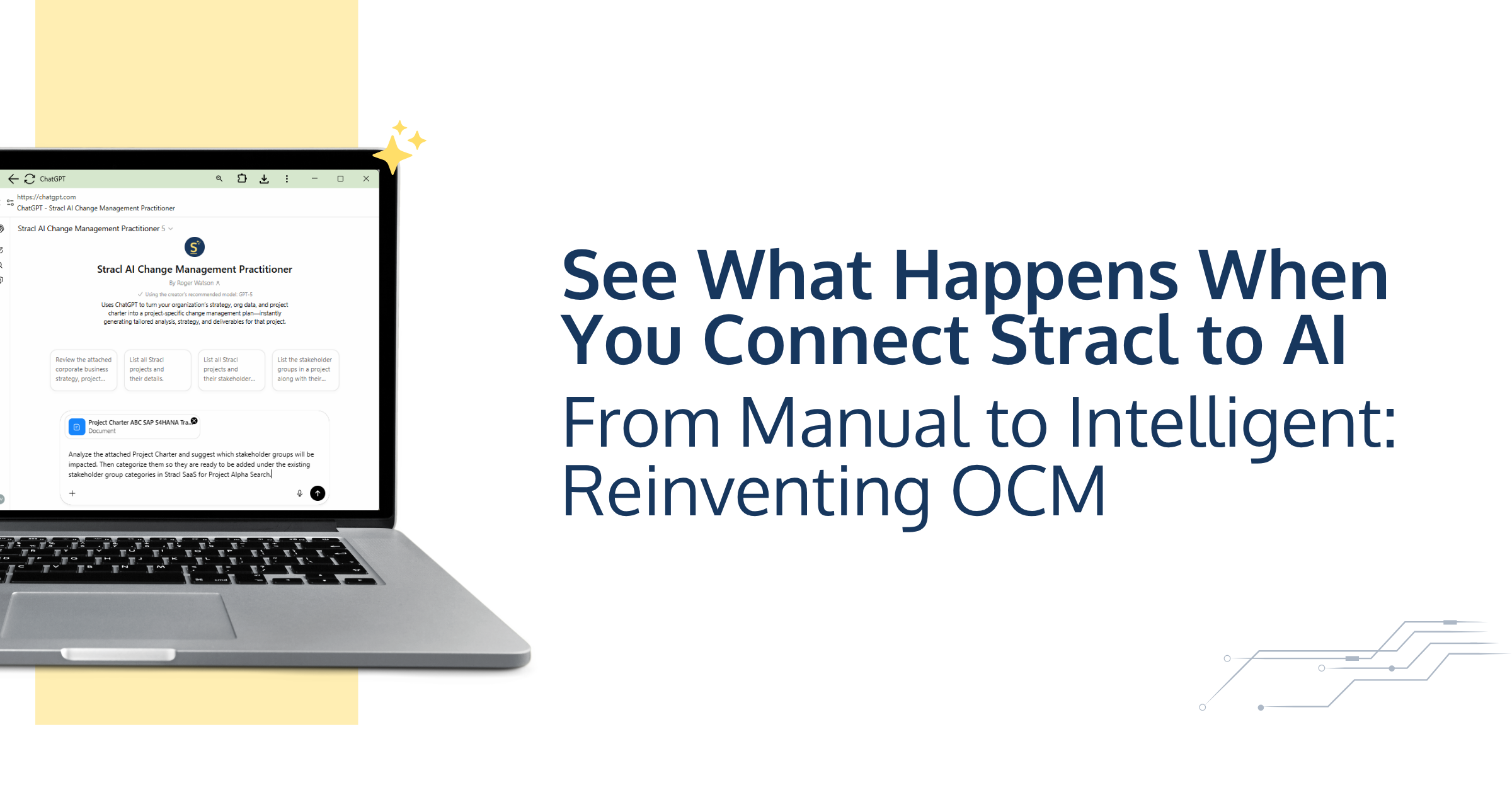
Stracl is a SaaS platform purpose-built for enterprise Organization Change Management (OCM). It gives change practitioners a structured, data-driven environment to plan and execute every dimension of a change program — from identifying who is affected, to communicating the “what’s in it for me,” to ensuring the right people have the right system access on go-live day.
And when you connect an AI assistant to Stracl using the Model Context Protocol (MCP), you move from structured data entry to conversational, intelligent acceleration. You can hand Stracl a stack of unstructured documents — a business case, a project charter, a statement of work, vendor invoices, org charts, meeting transcripts, and process diagrams — and have AI read them, reason about them, and populate your change program in minutes.
Here is what that looks like in practice.
1. Stakeholder Identification and Grouping
Define who is affected by your change. Stracl lets you create and manage stakeholder groups — logical collections of people organized by department, function, geography, or any dimension that matters to your program. Each group can be categorized, described, and linked to the employees who belong to it.
• Create stakeholder groups and categories
• Add and remove employees from groups
• Analyze stakeholder engagement levels across the organization
2. Communications and Engagement Planning
Plan and track every communication your change program requires. Stracl stores communications with full metadata — audience, channel, timing, owner, and status — so nothing falls through the cracks.
• Build a full communications calendar
• Track the delivery status of each message
• Tailor content by stakeholder group
3. Change Impact Analysis
Understand the depth and breadth of change across the organization. Stracl’s change impact module lets you document how specific groups are affected — by process, by system, by role — and assess the risk and severity of each impact.
• Log impacts by stakeholder group or position
• Rate severity and likelihood
• Track mitigation actions
4. Position and Role Management
Map your organizational structure within Stracl. Positions represent the roles that exist in your organization, independent of the individual filling them. This separation lets you plan for organizational design changes without being tied to specific headcount.
• Create and update positions
• Map employees to positions
• Track position-level impacts throughout the change
5. Security Role and T-Code Management (SAP and ERP Programs)
For organizations implementing SAP or other ERP systems, Stracl provides a structured way to manage security roles and transaction codes. You can define roles, assign T-codes to them, and map roles to organizational positions — giving you a complete picture of who will have access to what after go-live.
• Create and manage security roles
• Assign T-codes to roles
• Map roles to positions and compare against existing access
6. Org Data and Workforce Insights
Bring in your organizational data to give your change analysis a factual foundation. Stracl surfaces employee information — names, positions, reporting relationships — so your stakeholder analysis is grounded in reality, not assumptions.
• Assign T-codes to roles
• Map roles to positions and compare against existing access
7. Org Data and Workforce Insights
Bring in your organizational data to give your change analysis a factual foundation. Stracl surfaces employee information — names, positions, reporting relationships — so your stakeholder analysis is grounded in reality, not assumptions.
Connecting an AI assistant (such as Claude) to Stracl through the Model Context Protocol transforms Stracl from a structured data store into an intelligent change program accelerator. Here is what becomes possible.
1. Ingest Unstructured Documents and Populate Your Program
Hand the AI a business case, project charter, statement of work, or vendor software invoice — in any format. The AI reads and interprets the content, extracts the relevant change information, and populates Stracl automatically. What used to take days of manual entry takes minutes.
“Here is our project charter and the vendor SOW. Identify the scope of change, key milestones, and affected business units, then create the corresponding stakeholder groups in Stracl.”
2. Identify Stakeholders from Org Charts and Meeting Transcripts
The AI analyzes org charts, org data exports, and even raw meeting transcripts to surface who is likely affected by the change — and at what level of impact. It then creates or updates stakeholder groups in Stracl accordingly.
“Review this org chart and these meeting notes from the steering committee. Identify all stakeholder groups and add them to the project.”
3. Add and Organize Stakeholders Automatically
Once stakeholders are identified, the AI populates them in Stracl — creating groups, assigning categories, and mapping employees to the right groups — without requiring manual entry for each record.
“Based on the impacted departments we identified, create the stakeholder groups and add the employees from the org data.”
4. Build a Communications and Engagement Plan from Scratch
The AI drafts a full communications and engagement plan — audiences, messages, channels, timing, and owners — based on the project scope and stakeholder analysis. It then loads the plan directly into Stracl so the team can track execution.
“Write a 12-week communications and engagement plan for this go-live. Cover all stakeholder groups and include email, town hall, and manager cascade channels. Load it into Stracl.”
5. Perform Change Impact and Risk Analysis
The AI reviews process diagrams, system documentation, and project plans to identify where and how the change will hit the organization. It assesses risk by business role, process, and severity, then enters the findings into Stracl’s change impact module.
“Review these process diagrams and the system transition plan. Identify change impacts by business role and process and populate the change impact analysis in Stracl.”
6. Design and Plan Training
The AI analyzes the gap between current-state and future-state processes to identify training needs by role. It rapidly builds a training curriculum and development schedule tailored to every role affected by the change — all informed by the Stracl data already in the system.
“Based on the change impacts and the roles affected, rapidly build a training curriculum and development schedule. What topics are needed, for which groups, and in what sequence?”
7. Add Security Roles and Compare to Existing Access
The AI ingests security role design documents or vendor-provided access matrices, creates the roles and T-code assignments in Stracl, and then compares them against existing user access — highlighting differences, conflicts, and gaps in plain language.
“Here is the security design document. Load the roles and T-codes into Stracl, then compare them to the current access data and explain what is changing for each position.”
8. Generate Stakeholder Analysis Reports
The AI queries Stracl’s data and synthesizes a full stakeholder analysis narrative — summarizing who is affected, how, the communications and training planned for each group, and the overall change risk profile. Output can be formatted for executive consumption.
“Produce a stakeholder analysis summary for the steering committee covering all groups, their impact ratings, and the engagement plan.”
9. Answer Questions About Your Change Program in Natural Language
Because the AI has live access to Stracl’s data through MCP, any member of the project team can ask questions in plain English and get immediate, accurate answers — no need to log in or search through the application.
“Which stakeholder groups have not yet been assigned a communications owner?” or “What T-codes are assigned to the Procurement Manager role?”
10. Accelerate the Entire OCM Lifecycle
Taken together, these capabilities compress the timeline for standing up a change program dramatically. A practitioner who previously spent weeks gathering data, building spreadsheets, and populating templates can now direct an AI to do the heavy lifting — and focus their expertise on the decisions and relationships that drive adoption.
Enterprise change programs succeed or fail based on how well the organization is prepared. Stracl gives change leaders the structure to plan that preparation rigorously. AI connected through MCP gives them the speed to do it at the pace modern business demands.
Together, they make world-class OCM accessible to every organization undertaking an enterprise transformation — regardless of the size of the change team.
———
Stracl is a product of Stracl Inc., San Mateo, CA. For more information, visit stracl.com or contact Roger Watson, Principal, at +1 650 533 7267.
Blog and Events
October 6, 2026
Events
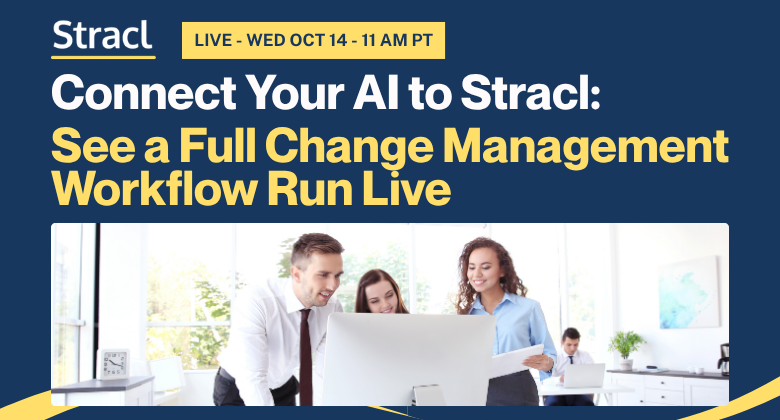
See your AI connect directly to Stracl, an OCM Execution Platform, and work with real change data. Register for this free live webinar below.
.png)
May 12, 2026
Insights
Create a powerful Stracl AI Agent with MCP in Microsoft Copilot Studio.
.png)
May 11, 2026
Insights
Enable Microsoft Copilot in Power BI so customers can ask natural language questions and find insights faster from their Stracl report data.

